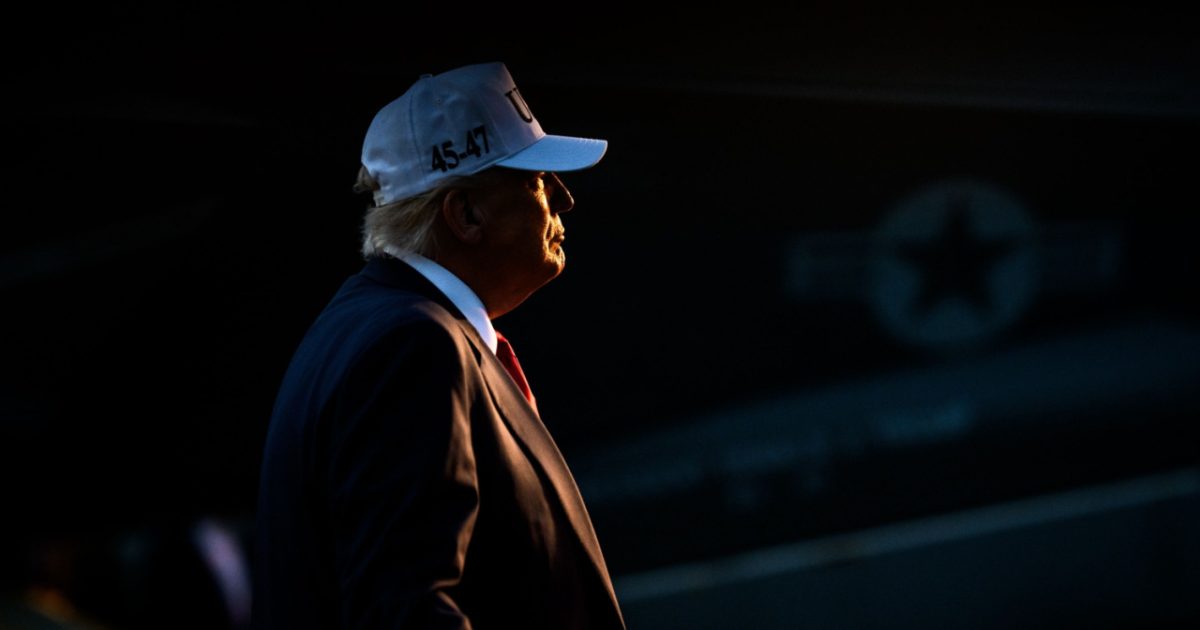
President Trump’s prime-time address Thursday night was billed as a major disclosure about election security. The predictable reaction from much of the legacy press was equally revealing. Several major outlets refused to even carry the speech. Worse, even before it began, headlines were already dismissing it as “baseless,” “debunked,” or “without evidence.” That response says less about the documents than about an institutional determination not to grapple with what they contain.
Whether one ultimately agrees with every conclusion President Trump drew is almost beside the point. The question is whether newly declassified intelligence, investigative records, and technical assessments deserve serious examination or instantaneous dismissal.
Apparently, much of the press has chosen the latter. The document release fell into five broad categories.
First, intelligence regarding Chinese acquisition of massive U.S. voter databases. According to the materials highlighted by the White House, Chinese actors acquired or possessed voter-registration information encompassing roughly 220 million Americans. Even if one disputes what China intended to do with that information, the acquisition itself is hardly trivial. It represents one of the largest collections of politically relevant personal data ever assembled by a foreign adversary.
Second, intelligence concerning Chinese election influence and interference planning. The released materials discuss Chinese capabilities, planning, and options for influencing American elections and exploiting political divisions. Whether every plan was executed is a separate question. Intelligence agencies routinely assess capabilities and intent precisely because waiting until every capability is fully employed is a dangerous way to conduct national security.
Third, documents addressing vulnerabilities in election infrastructure. The release includes technical assessments concerning voting systems, cybersecurity, and weaknesses that hostile foreign actors could exploit. Again, acknowledging vulnerabilities is not equivalent to proving that every vulnerability was successfully exploited. But neither should vulnerabilities be ignored simply because they are politically inconvenient.
Fourth, records concerning voter-registration irregularities and non-citizen registration issues. These documents address instances of industrial-scale fraudulent registrations and concerns regarding the accuracy of voter rolls. Reasonable people can debate the scale of the problem. What cannot reasonably be maintained is that election officials should simply refuse to investigate such questions.
Fifth, investigative and intelligence records that the prior administration had been withheld from public scrutiny. The very fact that these materials required declassification demonstrates that they were not part of the public debate when Americans were repeatedly assured that there was “nothing to see here.” Indeed, it now appears that the investigations of fraudulent voter registration efforts in several states, the capture of Chinese-made fake driver’s licenses, and other fraudulent schemes were deliberately slow-walked or buried to hide them from public view and to run the clock on criminal statutes of limitations.
The press, however, seems determined not to distinguish among these categories, or pay any mind to the egregious conduct of the prior administration’s duplicitous conduct. Everything is lumped together under the convenient label of “debunked.” That may be an effective rhetorical strategy, but it is a poor substitute for journalism.
Indeed, one obvious question deserves far more attention than it has received: Why would the Chinese Communist Party undertake an effort to obtain approximately 220 million American voter records if not because those records could facilitate influence over American elections? Or do we really believe Beijing simply wanted mailing addresses so it could send postcards from Xi Jinping?
That question answers itself.
No serious intelligence service spends time and resources harvesting one of the largest political databases in the world for idle curiosity. Foreign intelligence services collect information because information has value. They gather data because it can be analyzed, combined with other datasets, used to target messaging, identify political constituencies, recruit assets, conduct cyber operations, or support broader influence campaigns.
Perhaps none of this proves every allegation President Trump has made over the past six years. Honest observers can acknowledge that. But it certainly undermines the simplistic narrative that concerns about foreign election interference were nothing more than paranoid conspiracy theories.
What last night’s speech may ultimately vindicate is something more fundamental. For years, anyone who questioned election security was told there were no meaningful vulnerabilities, no significant foreign interest, and no reason for concern. Yet the very documents now being released discuss foreign collection of voter data, election-related intelligence, cybersecurity weaknesses, and investigative findings that government agencies themselves considered important enough to classify. That is not proof of every contested claim. It is, however, powerful evidence that the subject deserved far more serious treatment than it received.
Journalism is supposed to follow the facts wherever they lead. Instead, much of the national media appears determined to protect yesterday’s narrative from today’s documents.
That may preserve old headlines.
It does not vindicate the press.
The American people deserve better. These new disclosures should begin the inquiries that should have begun years ago.